What is Keirin Racing
Keirin (ケイリン?) is a track cycling event in which racing cyclists sprint for victory. Keirin originated in Japan in 1948; the first Olympic competitions in the sport occurred in 2000.
A keirin race is a mass-start race with 6-9[citation needed] sprinters riders and a paced start. Riders draw lots to determine starting positions and start as the pacer (usually a motorcycle, a derny, or a tandem bicycle) approaches. The riders are required to remain behind the pacer, which starts at the deliberately slow speed of about 25 km/h, gradually increases in speed and leaves the track approximately 600–700 meters before the end, at a speed of about 50 km/h. The first cyclist to finish the race is the winner (sometimes finishing at 70 km/h). Keirin races are about 2 kilometers in length (eight laps on a 250m track, six laps on a 333m track, and five laps on a 400m track).


In competitions, this event is often conducted in several rounds in order to reduce the number of competitors to one “final” round of 6–9 riders. Eliminated cyclists may get the opportunity to try again in the repechages (Repechage is a practice amongst ladder competitions that allows participants that failed to meet qualifying standards by a small margin to continue to the next round).
Typical Kerin Race
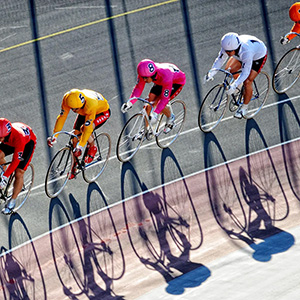
Keirin races in Japan begin with all nine cyclists parading to the starting blocks, bowing as they enter the track and again as they position their bikes for the start of the race. Every participant is assigned a number and a color for identification and betting purposes.
At the sound of the gun, the cyclists leave their starting blocks and attempt to gain position behind the pacer, a keirin bicyclist wearing purple with orange stripes. As the pace quickens, the pacer will usually depart the track with between one and two laps remaining, but the actual location where the pacer leaves varies with every race.
With 1½ laps remaining, officials begin sounding a bell or gong, increasing in frequency until the bicyclists come around to begin the final lap of the race.
The race is monitored by four referees, each located in a tower next to one of the four turns (referred to as corners). After every race, each referee will wave either a white or red flag. A white flag indicates that no infractions occurred in that area. A red flag, however, signals a possible infraction and launches an inquiry into the race. Judges then examine the race on videotape to decide if a participant committed a rules violation; if so, he is disqualified and retires from the remainder of the meet.
Keirin ovals are divided into specific areas: The two straightaways (homestretch and backstretch), the four turns (corners), and two locations called the “center”, referring to the area between corners 1 and 2 (1 center) and corners 3 and 4 (2 center).
Most keirin events are run at the standard distance of approximately 2,000 metres (6,600 ft),[2] with the highest-caliber events contested at a longer distance. The Keirin Grand Prix, for example, is run at 2,825 metres (9,268 ft), or seven laps around a 400-meter course.
Bets that can be made on Keirin races include:
Exacta (2車単, ni-sha-tan?) – selecting the first two finishers in exact order
Quinella (2車複, ni-sha-fuku?) – first two finishers in any order
Trifecta (3連単, san-ren-tan?) – first three finishers in exact order
Trio (3連複, san-ren-puku?) – first three finishers in any order
Quinella Place, or WIDE (ワイド, uaido?) – selecting two to finish in the top three, in any order.
Some Keirin velodromes accept the following wagers over the internet:[9][10]
K-3 – selecting the winner of each of the last three races of the day.
K-5 – selecting the winner of each of the last five races of the day.
BIG DREAM – selecting the first two finishers, in any order, in each of the last four races of the day.
The money wagered in the K-5 and BIG DREAM pools can carry over if there are no winning tickets.
See also: Parimutuel betting
In extraordinary circumstances, races have been declared no-contests, forcing velodromes to refund millions of yen in bets. Such results are generally known as a failure (不成立, fuseiritsu?). A race at Shizuoka velodrome on January 2, 2008 was declared a failure when the back wheel of the pacer’s bicycle nicked the bicycle of an actual competitor, causing him to fall.[11] In a race at Iwaki-Taira Velodrome on December 14, 2008, separate infractions resulted in the disqualification of the entire field; all but one of the competitors were handed a one-year suspension by the velodrome after the race.[12][13] The suspensions were lifted four months later.